When starting your journey into the Japanese language, one of the very first questions learners ask is what is Hiragana and why it is so important. Hiragana is the foundation of Japanese writing and plays a vital role in reading, writing, and understanding Japanese correctly. Whether you are a beginner or planning to appear for JLPT exams, understanding Hiragana is essential.
In this detailed guide, we will explain what is Hiragana in Japanese, its meaning, usage, examples, and how it differs from Katakana and Kanji. This article is designed to be beginner-friendly, informative, and fully SEO-optimized for learners who want clarity and depth.
If you are interested in learning Japanese professionally, you can also explore Japanese language resources here:
👉 Japanese Language Learning Resources
Table of Contents
What Is Hiragana?
What is Hiragana (ひらがな)?
Hiragana is one of the three main writing systems used in the Japanese language, alongside Katakana and Kanji. So, when learners ask what is Hiragana, the simplest answer is:
Hiragana is a phonetic Japanese script used to represent sounds.
Hiragana consists of 46 basic characters, each representing a specific syllable (sound). Unlike the English alphabet, Hiragana characters do not represent individual letters; instead, each character represents a complete sound, such as ka, ki, ku, ke, ko.
This is why Hiragana is often referred to as the hiragana alphabet, even though it functions differently from the English alphabet.
What Is Hiragana in English?
Many beginners wonder what is Hiragana in English. In simple terms, Hiragana can be compared to phonics in English.
For example:
- あ = a
- か = ka
- さ = sa
- た = ta
Each Hiragana character maps directly to a sound, making pronunciation easier for learners. Once you master Hiragana, reading Japanese becomes much more manageable, even before learning Kanji.
What Is Hiragana Alphabet?
The hiragana alphabet consists of:
- 46 basic characters
- Additional variations using diacritics (゛and ゜)
- Combination sounds like kya, shu, cho
Unlike English A–Z, Hiragana follows a structured sound system based on vowels and consonant-vowel combinations.
For example:
- Vowels: あ (a), い (i), う (u), え (e), お (o)
- K-row: か (ka), き (ki), く (ku), け (ke), こ (ko)
This structure makes Hiragana easier to memorize and write.
What Is Hiragana Used For?
To fully understand what is Hiragana used for, you need to see how Japanese sentences are formed.
Hiragana is mainly used for:
- Grammatical particles (は, が, を, に)
- Verb and adjective endings
- Native Japanese words without Kanji
- Furigana (reading aid above Kanji)
- Beginner-level reading and writing
For example:
わたしはがくせいです
(Watashi wa gakusei desu)
“I am a student.”
In this sentence, Hiragana plays a crucial grammatical role.
What Is Hiragana Words?
What is Hiragana words?
Hiragana words are words written completely in Hiragana without using Kanji or Katakana.
Examples include:
- ありがとう (thank you)
- こんにちは (hello)
- さようなら (goodbye)
- これ (this)
- それ (that)
These words are commonly used in daily Japanese conversation and beginner-level reading materials.
What Is Hiragana and Katakana?
A very common question is what is hiragana and katakana, and how they differ.
Hiragana:
- Used for native Japanese words
- Used for grammar and sentence structure
- Curved and soft in appearance
Katakana:
- Used for foreign words
- Used for brand names and technical terms
- Sharp and angular in appearance
Example:
- さくら (sakura – Hiragana)
- コンピュータ (computer – Katakana)
Both scripts are essential, but Hiragana is always learned first.
What Is Hiragana, Katakana and Kanji?
To fully understand Japanese writing, learners must know what is Hiragana, Katakana and Kanji.
Hiragana:
- Phonetic script
- Grammar and native words
Katakana:
- Phonetic script
- Foreign words and emphasis
Kanji:
- Logographic characters
- Borrowed from Chinese
- Represent meaning rather than sound
If you want a detailed explanation of Kanji, read here:
👉 What Is Kanji Used in Japanese
What Is Hiragana vs Kanji?
Understanding what is hiragana vs kanji helps learners avoid confusion.
| Hiragana | Kanji |
| Represents sound | Represents meaning |
| Easy to learn | Takes time to master |
| 46 characters | Thousands of characters |
| Used for grammar | Used for content words |
Example:
- たべる (taberu – Hiragana)
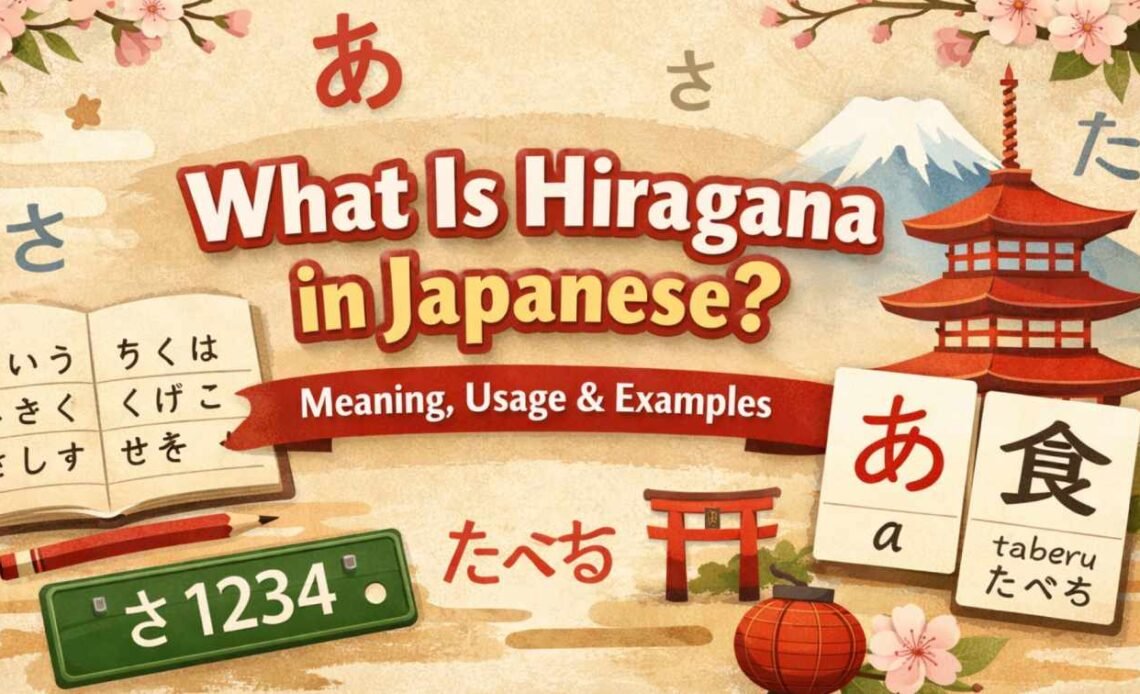
- 食べる (taberu – Kanji + Hiragana)
Both scripts work together to form natural Japanese sentences.
What Is Hiragana on License Plate?
An interesting real-world usage question is what is hiragana on license plate.
In Japan, vehicle license plates often include a Hiragana character. This character does not indicate pronunciation but is used to classify the type of vehicle (private, commercial, rental, etc.).
For example:
- さ, す – Private vehicles
- れ – Rental cars
This shows how deeply Hiragana is integrated into everyday Japanese life.
How to Learn Hiragana Easily
If you are serious about learning Japanese, mastering Hiragana should be your first step. Some effective methods include:
- Daily writing practice
- Flashcards
- Reading children’s books
- Watching Japanese videos with subtitles
You can also explore this helpful guide:
👉 Easy Way to Learn Japanese Language
Importance of Hiragana for JLPT Exams
Hiragana is essential for all JLPT levels (N5 to N1). Without Hiragana, it is impossible to:
- Read exam questions
- Understand grammar
- Write correct answers
If you are planning JLPT preparation, check out:
👉 Best Institutes in Delhi for JLPT
Learn Hiragana Through Online Japanese Classes
If you prefer learning from home, online learning is a great option. Structured classes help with pronunciation, writing practice, and real-time doubt clearing.
👉 Online Japanese Classes for Beginners
Professional Japanese Language Training in Delhi
If you want to learn more about Hiragana or learn Hiragana in the Japanese language, please contact us here.
They provide excellent training and have been teaching for the past 8 years. Along with teaching, they also help students go to Japan for studies, if you are interested in studying there.
📍 Institute Details:
- Address:
2/81, 2nd Floor, Lalita Park, Laxmi Nagar, New Delhi, Delhi, 110092 - Google Maps:
https://share.google/aMEca9SavZu515Csy - Website:
www.teamlanguages.com - Phone:
87009 56038 - Timings:
7 Days Open | 9 am – 7 pm
Conclusion
Now that you clearly understand what is Hiragana, its meaning, usage, and real-world examples, you can confidently begin your Japanese language journey. Hiragana is the backbone of Japanese writing, and mastering it opens the door to reading, speaking, and understanding Japanese fluently.
Whether your goal is casual learning, JLPT preparation, or studying in Japan, Hiragana is your first and most important step.
FAQs
1. What is Hiragana used for?
Hiragana is primarily used in Japanese for writing native words, grammatical particles, and verb endings. It helps beginners read and pronounce Japanese accurately before learning Kanji. Hiragana is also used in Furigana, which shows Kanji readings. To learn Hiragana and other scripts effectively, check out our guide on Japanese language resources. You can also explore online lessons through Online Japanese Classes for Beginners to strengthen your Hiragana skills.
2. What is the difference between Hiragana and Katakana?
Hiragana is used for native Japanese words and grammar, while Katakana is used for foreign words, brand names, and emphasis. Hiragana has a soft, curved style, whereas Katakana is angular. Understanding the difference is crucial for reading and writing Japanese correctly. For a deeper understanding of Japanese scripts, including how Hiragana complements Kanji, see What is Kanji in Japanese or What is Kanji?.
3. Is Hiragana an alphabet?
Hiragana is often called the “Japanese alphabet,” but it is technically a syllabary, meaning each character represents a syllable rather than a single letter. It forms the foundation of reading and writing in Japanese and is essential before learning Kanji and Katakana. Beginners can start learning with structured courses, such as Easy Way to Learn Japanese Language or Online Japanese Classes for Beginners.
4. What is one in Japanese Hiragana?
The number “one” in Japanese is いち (ichi), written in Hiragana as いち. Hiragana makes it simple to pronounce numbers and words without relying on Kanji. Learning numbers in Hiragana is an essential step for beginners. To practice basic Hiragana including numbers, you can refer to Japanese language resources or join Best JLPT Coaching in Delhi for structured lessons.
5. What is Hiragana?
Hiragana is one of the three scripts in Japanese, along with Katakana and Kanji. It is a phonetic writing system where each character represents a syllable. Hiragana is used for grammar, native words, and reading aids for Kanji. Beginners often start by learning Hiragana to develop reading and writing skills. You can explore more about Japanese scripts and learning methods through Easy Way to Learn Japanese Language or Best Institutes in Delhi for JLPT.
6. How is Hiragana used in the Japanese writing system?
Hiragana is used alongside Kanji and Katakana in the Japanese writing system. It represents grammatical elements, verb endings, and native words, while Kanji shows meaning and Katakana represents foreign words. Hiragana is essential for reading simple sentences and forming grammatically correct text. To master Hiragana, consider Online Japanese Classes for Beginners or Japanese Language Resources for guided lessons.
7. How many characters are there in Hiragana?
The Hiragana system consists of 46 basic characters, along with additional diacritics and combinations to form over 70 syllables. These characters represent all the sounds used in the Japanese language. Learning all Hiragana characters is the first step in reading and writing Japanese fluently. Beginners can follow courses like Easy Way to Learn Japanese Language or enroll in Best JLPT Coaching in Delhi to master Hiragana effectively.
8. What sounds or syllables does each Hiragana character represent?
Each Hiragana character represents a syllable, not a single letter. For example, あ = a, か = ka, さ = sa. This phonetic system allows learners to read and write words accurately before mastering Kanji. Understanding the sound system of Hiragana is vital for pronunciation and grammar. You can explore interactive exercises at Online Japanese Classes for Beginners or refer to Japanese language resources for more examples.
9. Can I learn Hiragana online?
Yes, you can learn Hiragana effectively through online classes. Structured online programs provide lessons on pronunciation, writing, and reading comprehension. Beginners can start with Online Japanese Classes for Beginners or explore easy-to-follow methods through Easy Way to Learn Japanese Language. These programs help you build a strong foundation for Katakana, Kanji, and JLPT preparation.
10. How does Hiragana help with learning Kanji?
Hiragana supports Kanji learning by providing Furigana, which shows the pronunciation of Kanji characters. It helps beginners read Japanese texts accurately without memorizing every Kanji immediately. Understanding Hiragana is essential before progressing to Kanji. For a detailed guide, see What is Kanji in Japanese or What is Kanji? to complement your Hiragana knowledge.
